
Cold Upsetting Services
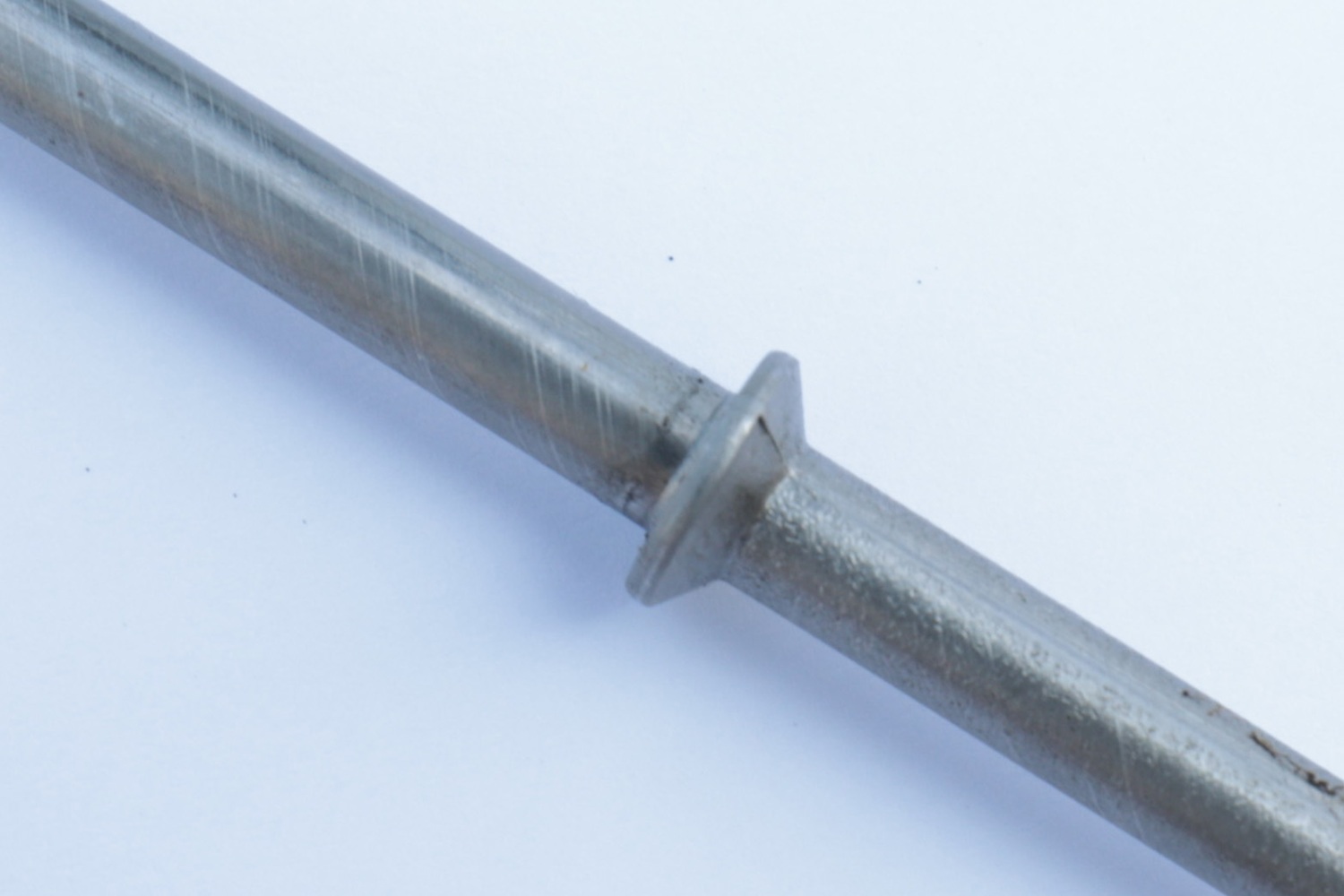 Close-up of a metal rod with an integral collar produced by cold upsetting
Pi Chan Metal forms integral collars by locally compressing metal rods without preheating. The raised collar is formed directly from the rod material, without welding on a separate ring. Submit your drawing to discuss collar dimensions, position, and manufacturing feasibility.
Cold Upsetting Services for Integral Collars on Metal Rods
Cold upsetting uses compressive force to shorten a local section of metal and increase its cross-section without preheating the workpiece. For a rod with an integral collar, material from the rod is displaced outward to create a raised feature.
Pi Chan Metal Co., Ltd., based in Changhua, Taiwan, welcomes drawing-based inquiries for cold upsetting services involving metal rod components. A distinctive application is forming a collar directly from the rod material, without welding or assembling a separate ring onto the shank.
Submit your drawing to discuss the required collar geometry, rod dimensions, material, tolerances, and manufacturing feasibility.
How Cold Upsetting Forms a Raised Feature
During upsetting, compression causes material to flow into an enlarged section. The resulting shape depends on the workpiece, tooling, material behavior, and required geometry.
The word “cold” refers to forming without preheating the workpiece. It does not mean that the workpiece temperature remains unchanged throughout deformation.
At Pi Chan, the practical feature to highlight is the continuous connection between the formed collar and the rod. The raised section comes from the parent material rather than an added ring.
| Process Characteristic | Meaning for the Component |
|---|---|
| Local compression | Material is displaced within a selected section |
| Increased cross-section | A raised feature is formed from the rod |
| No workpiece preheating | Identifies the cold-forming approach described here |
| Integral construction | Collar and rod remain one continuous piece |
| Drawing-defined geometry | Finished dimensions require an agreed specification |
| Design review | Material and shape must be assessed together |
For an overview of the finished feature, visit integral collar forming at Pi Chan Metal.
Cold Upsetting for Mid-Shank Integral Collars
Upset features are not limited to the end of a component. A drawing may require a collar along the rod body at a controlled distance from an end or another reference.
The collar’s purpose determines which dimensions matter most. It may provide a stop, locate another component, or create a defined contact surface, depending on the assembly design.
| Collar Requirement | Information to Provide |
|---|---|
| Outside diameter | Finished diameter and permitted variation |
| Axial thickness | Required width of the raised feature |
| Position | Distance from a clearly identified datum |
| Profile | Required edge and transition geometry |
| Functional face | Surface that contacts or locates a mating part |
| Adjacent rod sections | Relevant diameters and lengths |
| Loading conditions | Forces and contact conditions affecting the feature |
One-piece construction does not establish a load rating by itself. Performance must be evaluated against the actual material, geometry, and application.
Is Cold Upsetting Suitable for Your Design?
Feasibility depends on more than the finished collar diameter. The material, amount of deformation, available forming length, feature position, tooling access, and dimensional requirements all affect the review.
Provide the complete part drawing rather than an isolated sketch of the collar. Additional threads, bends, or end features may influence how the component can be manufactured.
| Review Factor | Question to Resolve |
|---|---|
| Material | Can the specified material accommodate the required deformation? |
| Rod dimensions | What diameter and length are required? |
| Collar geometry | Can the proposed profile be formed consistently? |
| Feature location | Is the position compatible with the manufacturing arrangement? |
| Other features | How do threads, bends, and ends relate to the collar? |
| Tolerances | Which dimensions control assembly function? |
| Quantity | What production and tooling arrangements are appropriate? |
Do not assume that a feature feasible in one material or size can be reproduced unchanged in another.
Cold Upsetting Compared with Other Manufacturing Routes
A raised collar can be produced by forming, machining, or attaching a separate component. The appropriate route depends on the complete specification.
For Pi Chan’s integral collar construction, cold upsetting creates the feature from the rod itself and avoids attaching a separate ring. Any comparison of total cost, material use, or performance should be made for the actual designs.
| Manufacturing Route | How the Raised Feature Is Produced | Main Review Point |
|---|---|---|
| Cold upsetting | Rod material is displaced under compression | Formability and achievable geometry |
| Machining from larger stock | Material is removed to leave the raised section | Stock dimensions and machining requirements |
| Welded-on ring | A separate ring is joined to the rod | Joint and welding requirements |
| Mechanically attached collar | A separate component is secured to the rod | Retention, adjustment, and assembly needs |
A fixed integral collar may not suit an assembly that requires adjustment or removal. Confirm the intended function before changing the construction.
Material Requirements for Cold Upsetting
Specify the required material grade and finished-part properties. A broad description such as “steel rod” does not fully define the material requirement.
The material’s condition also matters. If the drawing requires a particular hardness, strength, or treatment, include that information in the inquiry.
Material suitability and the required processing sequence must be reviewed together. Cold upsetting should not be assumed suitable for every metal or every degree of deformation.
| Material Information | What to Specify |
|---|---|
| Grade | Material designation or applicable specification |
| Condition | Required supply or finished condition |
| Mechanical properties | Strength, hardness, or other requirements |
| Service environment | Temperature, moisture, chemicals, and exposure |
| Surface treatment | Required finish or coating |
| Verification | Required records or testing |
Confirm material and finish availability for the proposed configuration before approving the purchase specification.
Drawing Requirements for an Accurate Quotation
A useful drawing shows the finished component, its references, and the tolerances that affect fit.
Define collar location from a functional datum. Where one collar face establishes the assembly position, identify that face rather than leaving its role implicit.
| Drawing Item | Required Detail |
|---|---|
| Overall part | Length, diameters, units, and revision |
| Formed feature | Diameter, thickness, location, and profile |
| Transitions | Relevant radii and clearance requirements |
| Geometric controls | Straightness, alignment, or other functional requirements |
| Threads | Designation, coverage, and position, if applicable |
| Ends and bends | Complete dimensions and orientation |
| Material and finish | Required specifications |
| Acceptance criteria | Critical inspection and performance requirements |
For components combining upset collars with fastening features, explore special screw manufacturing.
Tolerances and Mating-Part Clearance
Tolerance requirements should reflect the component’s function. The collar diameter may control radial clearance, while its location may determine where another part seats.
Check the transition between the collar and rod against the mating component. A hole that clears the shank may still interfere with the raised profile.
For long rods, identify straightness requirements when alignment affects installation. Agree on the relevant measurement references and inspection method.
Pi Chan’s extra long screws category provides a related starting point for extended-length inquiries. Each combination of length and formed features requires confirmation.
Inspection and Sample Evaluation
Agree on acceptance criteria before samples or production parts are evaluated.
If samples are supplied, check them against the controlled drawing and representative mating components. Record the drawing revision and evaluation results.
| Inspection Topic | Requirement to Agree |
|---|---|
| Collar dimensions | Diameter, thickness, and profile |
| Collar location | Datum and positional tolerance |
| Rod geometry | Diameter, length, and straightness where required |
| Transition areas | Drawing conformity and acceptable surface condition |
| Additional features | Thread, end, or bend requirements |
| Material properties | Required evidence or tests |
| Surface finish | Treatment and defect limits |
| Functional fit | Seating, clearance, and assembly checks |
These are topics for agreement with the supplier. Inspection, testing, sampling, and documentation availability require confirmation for each project.
Request a Cold Upsetting Services Review
Send your drawing and explain what the raised feature does in the assembly. Include the material, required quantity, finish, delivery destination, and requested date.
If you are replacing a welded or assembled collar, provide the existing design and the requirements the alternative must retain.
| Inquiry Item | Information to Include |
|---|---|
| Part identification | Drawing number and revision |
| Geometry | Rod dimensions and collar details |
| Function | Mating components and intended use |
| Material | Grade and required properties |
| Finish | Surface treatment and acceptance criteria |
| Quantity | Initial order and expected repeat demand |
| Approval | Sample, inspection, and documentation requirements |
| Delivery | Destination and requested date |
For related capabilities, see metal forming and processing.
Contact Pi Chan Metal to discuss feasibility, tooling requirements, minimum order quantity, pricing, and delivery arrangements.
Cold Upsetting Services FAQ
What Is Cold Upsetting?
Cold upsetting is a forming operation that compresses a section of metal, shortening it locally while increasing its cross-section. The workpiece is formed without preheating. The required shape depends on the material, tooling, and geometry.
How Does Cold Upsetting Create an Integral Collar?
Compression displaces material from the rod into a raised section. The resulting collar remains part of the same continuous workpiece rather than being attached as a separate ring.
Is the Collar Welded onto the Rod?
For Pi Chan’s integral collar construction, a separate welded-on ring is not used. The collar is formed directly from the rod material.
Is Cold Upsetting the Same as Cold Heading?
The terms are related. Upsetting describes the compression operation that enlarges a section. Cold heading commonly refers to cold-forming operations used to produce heads and other features. Use the actual feature and process requirements when discussing a project.
Is Cold Upsetting the Same as Extrusion?
No. Upsetting enlarges a section through compression, while extrusion involves forcing material to flow through or around tooling to create a different geometry. A manufacturing sequence may involve more than one operation.
Can a Collar Be Formed in the Middle of a Rod?
Pi Chan’s described capability includes raised features along the rod body. Submit the required location, dimensions, and material for review. The complete design determines feasibility.
What Collar Diameter Can Be Produced?
The achievable diameter depends on the rod material, starting dimensions, deformation requirements, and tooling. Provide the required finished geometry rather than assuming a universal diameter limit.
Can Any Material Be Cold Upset?
No universal suitability should be assumed. Material grade, condition, and required deformation affect feasibility. Include the specified material and finished-part properties in the inquiry.
Does Cold Upsetting Guarantee a Stronger Part?
Not by itself. Strength depends on material, processing, geometry, and loading. Any performance claim or comparison requires evidence for the particular component.
Does Cold Upsetting Eliminate All Machining?
Not necessarily. Additional operations may be needed to meet the complete drawing. Discuss the finished component rather than assuming the formed feature removes every subsequent process.
Can Threads or Bends Be Included?
Show all features on the drawing, including their relationship to the collar. The complete combination must be reviewed before manufacturing feasibility and process arrangements can be confirmed.
Can an Integral Collar Replace an Adjustable Collar?
A fixed integral feature does not provide the same adjustment function as a separate movable collar. Identify installation and service requirements before considering a replacement.
What Information Is Needed Without a Drawing?
Provide measured dimensions, photographs, sample information, and an explanation of the function. These can help define the request, but a controlled specification should be agreed before production.
Are Samples Available Before Production?
Ask about availability, cost, and lead time during quotation. If samples are supplied, evaluate them using agreed dimensional and functional acceptance criteria.
What Determines Minimum Order Quantity and Lead Time?
Geometry, material, tooling, finish, quantity, inspection requirements, and production scheduling affect the quotation. Include the delivery destination and required date with your inquiry.