
S Hook
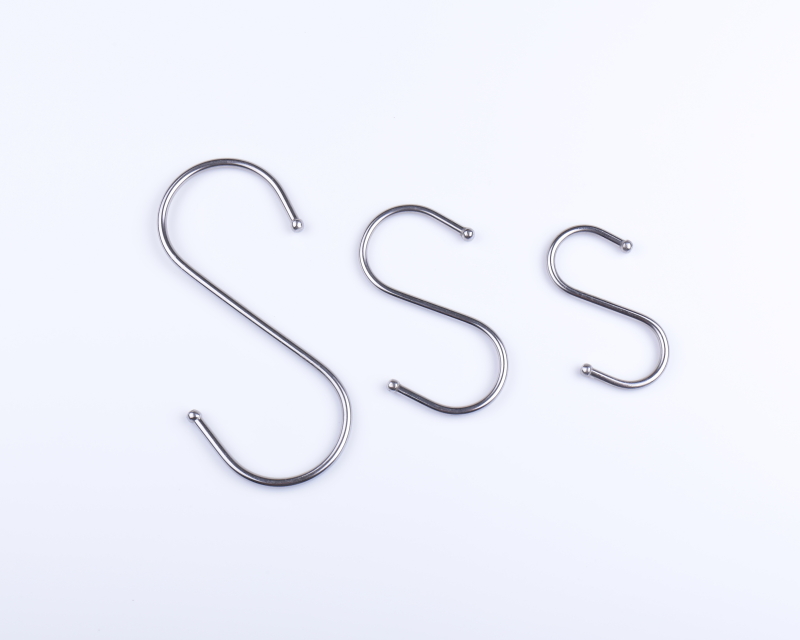 Three S hooks in different sizes with enlarged rounded tips
S hooks in three sizes, featuring enlarged rounded tips at both ends. Submit your required dimensions, opening widths, and application details to Pi Chan Metal for review.
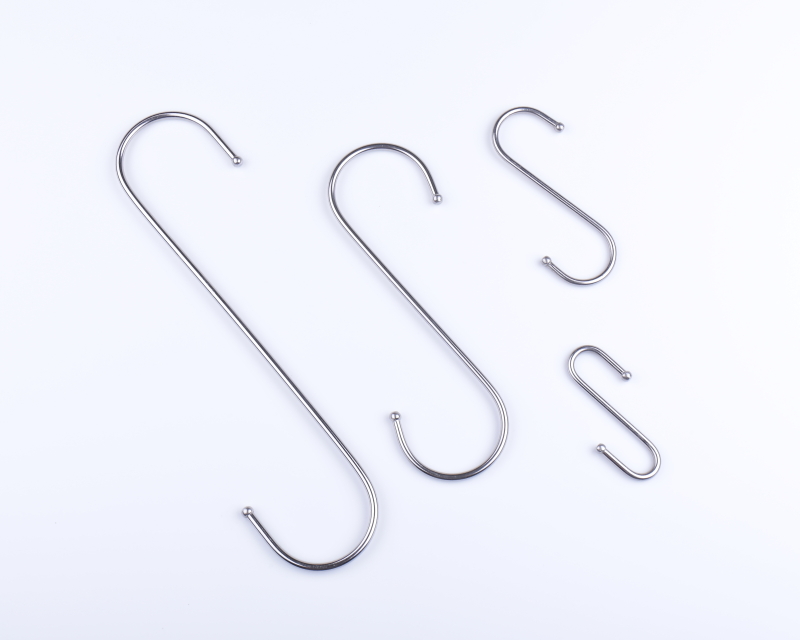 Four S hooks with different lengths, curved profiles, and end openings
S hooks with varied lengths and curved profiles. Check both end openings against your rails, rings, or hanging components, and contact Pi Chan Metal to discuss the required configuration.
S Hook Manufacturer in Taiwan for Hanging and Organization
An S hook connects two items through opposing curved ends. Its open shape allows attachment to compatible rails, rings, or hanging points without a threaded connection.
Choosing the right S hook requires more than matching overall length. The rod diameter, opening width, bend geometry, end shape, and supporting components all influence fit and performance.
Pi Chan Metal Co., Ltd., based in Changhua, Taiwan, presents S hooks with one-piece construction and enlarged tips formed at the ends. For a purchasing inquiry, provide a drawing and application details so the requested dimensions and manufacturing feasibility can be reviewed.
Learn more about Pi Chan Metal Co., Ltd. and its metal product categories.
One-Piece S Hooks with Enlarged Tips
The end shape is an important feature of an S hook. An enlarged tip changes the contact profile compared with a plain-cut rod end and can affect how the hook passes through an opening.
Pi Chan describes its S hook design as one-piece construction with formed, enlarged ends. Buyers should specify the required tip dimensions and surface condition alongside the overall hook geometry.
An enlarged end is not a closing latch. The hook remains open, so retention depends on the opening, orientation, mating components, and movement during use.
| Product Feature | What to Review | Why It Matters |
|---|---|---|
| One-piece body | Body geometry and dimensional requirements | Defines the basic hook configuration |
| Enlarged tips | Tip diameter, shape, and position | Affects clearance and contact |
| Opposing curves | Bend dimensions at both ends | Determines compatibility with mating parts |
| Open ends | Clear opening after end forming | Controls attachment and removal |
| Surface condition | Burrs, roughness, and finish | Matters where the hook contacts other items |
A complete drawing should show the finished hook, including both enlarged tips and the remaining clear openings.
S Hook Dimensions to Specify Before Ordering
“Small,” “large,” and “heavy-duty” are not complete specifications. Use measurable dimensions so the supplier can assess the request accurately.
Where the two ends have different dimensions, identify them separately. Also state whether the hook lies in one plane or requires another orientation.
| Dimension | Information to Provide |
|---|---|
| Overall length | Total external length of the finished hook |
| Overall width | Maximum external width |
| Rod diameter | Required body diameter and tolerance |
| Upper opening | Clear gap at the upper end |
| Lower opening | Clear gap at the lower end |
| Inner bend dimensions | Space available for the rail, ring, or hanging component |
| Tip dimensions | Enlarged-end size and shape |
| End alignment | Required relationship between both hook ends |
| Tolerances | Permitted variation in critical dimensions |
These are inquiry details rather than a confirmed list of available sizes. Dimensions and manufacturing feasibility must be reviewed for the requested design.
Match the Hook to the Rail and Hanging Component
Both ends of an S hook need to fit their respective connections. A hook may fit the supporting rail but fail to pass through the ring or handle of the item being hung.
Measure the mating parts, including their thickest sections. Account for the enlarged tips when checking whether the hook can be inserted and removed.
| Mating Component | Details to Check | Fit Consideration |
|---|---|---|
| Round rail | Outside diameter | Inner curve must accommodate the rail |
| Ring or eyelet | Internal opening and section thickness | Enlarged tip must pass through the opening |
| Flat bar | Width, thickness, and edge profile | Contact differs from a round rail |
| Product handle | Opening and material | Check clearance and surface contact |
| Display grid | Wire diameter and spacing | Confirm installation path and orientation |
| Moving assembly | Range and direction of movement | Review the possibility of disengagement |
A sample trial using the actual mating components can reveal fit problems that are difficult to identify from overall dimensions alone.
S Hook Applications and Selection Priorities
S hooks may be considered for storage, display, and hanging arrangements where an open, removable connection suits the application.
Selection should reflect the complete assembly, including the support structure and hanging item. The examples below describe application considerations rather than confirmed load ratings or approved uses.
| Application | Selection Priority | Information to Include in an Inquiry |
|---|---|---|
| Retail displays | Appearance and compatibility with display hardware | Rail, grid, and product attachment dimensions |
| Workshop organization | Fit with racks and item handles | Contact geometry and intended loading |
| Household storage | Ease of attachment and surface contact | Supporting rail and hanging-item details |
| Garment accessories | Contact with fabric or straps | Tip shape and surface requirements |
| Plant displays | Exposure and changing suspended weight | Support arrangement and service environment |
| Product assemblies | Repeatable dimensions and fit | Controlled drawing and acceptance criteria |
For a different hanging configuration, explore clothes hooks or orchid hooks and compare the geometry with your intended assembly.
Material and Surface Finish Requirements
Specify the required material grade instead of relying on appearance. A polished surface does not establish that a hook is stainless steel, and a coating color does not establish corrosion performance.
Material and finish requirements should reflect moisture, cleaning chemicals, contact materials, and the intended service environment.
| Requirement | Details to Specify |
|---|---|
| Material | Required grade or material specification |
| Surface treatment | Coating, polishing, or other requested finish |
| Exposure | Indoor, humid, outdoor, or other conditions |
| Contact surfaces | Materials touching the hook |
| Appearance | Color, gloss, and acceptable surface variation |
| Surface quality | Requirements for burrs, roughness, and visible defects |
| Verification | Agreed documentation or testing, if required |
Availability must be confirmed for the requested combination of material, dimensions, and finish.
Load Requirements Must Be Confirmed for the Actual Design
An S hook’s appearance or rod diameter alone does not establish its allowable load. Material properties, bend geometry, contact positions, and load direction also matter.
Provide the expected loading conditions when submitting an inquiry. Identify whether the load is stationary or subject to movement, vibration, or impact.
An open S hook should not be assumed suitable for lifting, overhead suspension, fall protection, or transport restraint. Such applications require purpose-designed hardware and relevant verified ratings.
The condition of the supporting rail, ring, or frame also affects the connection. Review the complete assembly rather than treating the hook as an isolated component.
Inspection and Sample Approval
Agree on the critical dimensions and surface requirements before production. For hooks with enlarged tips, inspect the finished opening rather than relying only on dimensions taken before end forming.
| Inspection Item | Acceptance Requirement to Agree |
|---|---|
| Overall geometry | Length, width, and end alignment |
| Body diameter | Required size and tolerance |
| Openings | Finished clear gaps at both ends |
| Enlarged tips | Dimensions, shape, and consistency |
| Surface condition | Agreed finish and defect limits |
| Assembly fit | Compatibility with representative mating parts |
| Performance | Any required application-specific testing |
| Identification | Part number, drawing revision, and packaging details |
These are topics to agree with the supplier, not a statement that every inspection or test is included with every order.
If samples are supplied, evaluate them with the actual supporting and hanging components. Record the approved drawing revision and any agreed acceptance conditions.
Request an S Hook Quotation from Pi Chan Metal
A complete inquiry helps establish a clear quotation basis and reduces follow-up questions.
| Inquiry Item | Information to Include |
|---|---|
| Drawing | Dimensions, units, tolerances, and revision |
| End design | Tip shape and finished opening requirements |
| Material and finish | Required grade and surface treatment |
| Application | What the hook connects |
| Mating components | Rail, ring, handle, or other connection dimensions |
| Loading | Expected load and movement conditions |
| Quantity | Initial order and estimated repeat demand |
| Approval | Sample, inspection, and documentation requirements |
| Delivery | Destination and requested date |
For drawing-specific metal components, see metal forming and processing.
Contact Pi Chan Metal to discuss manufacturing feasibility, minimum order quantity, pricing, and delivery arrangements.
S Hook FAQ
What Is an S Hook?
An S hook is a connector with two opposing curved ends resembling the letter S. It can connect compatible hanging points without a threaded connection. Its suitability depends on dimensions, material, loading, and the complete assembly.
What Is the Purpose of Enlarged Tips?
Enlarged tips change the end profile and contact geometry. They also affect the clearance needed to pass through a ring, eyelet, or handle. Specify the required end dimensions and check them against the mating components.
Does an Enlarged Tip Prevent Accidental Release?
Not by itself. An enlarged tip does not close the hook. Retention depends on the clear opening, orientation, mating geometry, and movement. If positive closure is required, evaluate a suitable closed or locking connector.
How Do I Choose the Correct S Hook Size?
Check overall length, rod diameter, inner bend dimensions, and both clear openings. Measure the supporting rail and the item being hung. Confirm that the enlarged tips can pass through the required openings.
Can the Two Ends Have Different Openings?
Include the requested dimensions in your drawing for review. Different upper and lower openings may suit different mating components, but manufacturing feasibility must be confirmed for the proposed geometry.
How Much Weight Can an S Hook Hold?
There is no universal capacity for all S hooks. A verified rating must relate to the particular material, dimensions, loading direction, and test conditions. Do not assign a load limit from appearance or size alone.
Can S Hooks Be Used Outdoors?
Outdoor suitability depends on material grade, finish, exposure, and contact with other materials. Describe the environment when requesting a quotation. A general description such as “rustproof” is not a complete requirement.
Are S Hooks Suitable for Lifting?
A general-purpose S hook should not be assumed suitable for lifting. Use hardware specifically designed and rated for the lifting application, with the required supporting documentation and instructions.
Can I Bend an S Hook to Change Its Opening?
Avoid treating manual bending as an approved adjustment. It changes the geometry and may affect performance or damage the finish. Specify the required finished opening before ordering.
Can Pi Chan Review Custom S Hook Dimensions?
Submit a drawing showing overall dimensions, rod diameter, bend geometry, openings, tip details, material, and finish. Include quantity and application information so feasibility can be assessed.
Are Samples Available Before a Bulk Order?
Ask about sample availability, cost, and lead time when submitting your inquiry. If samples are supplied, evaluate fit and surface condition using the intended mating components and agreed acceptance criteria.
What Are the Minimum Order Quantity and Lead Time?
They depend on the design, material, finish, quantity, tooling requirements, and production schedule. Request confirmation with your quotation and provide the required delivery date and destination.