
Integral Collar Forming
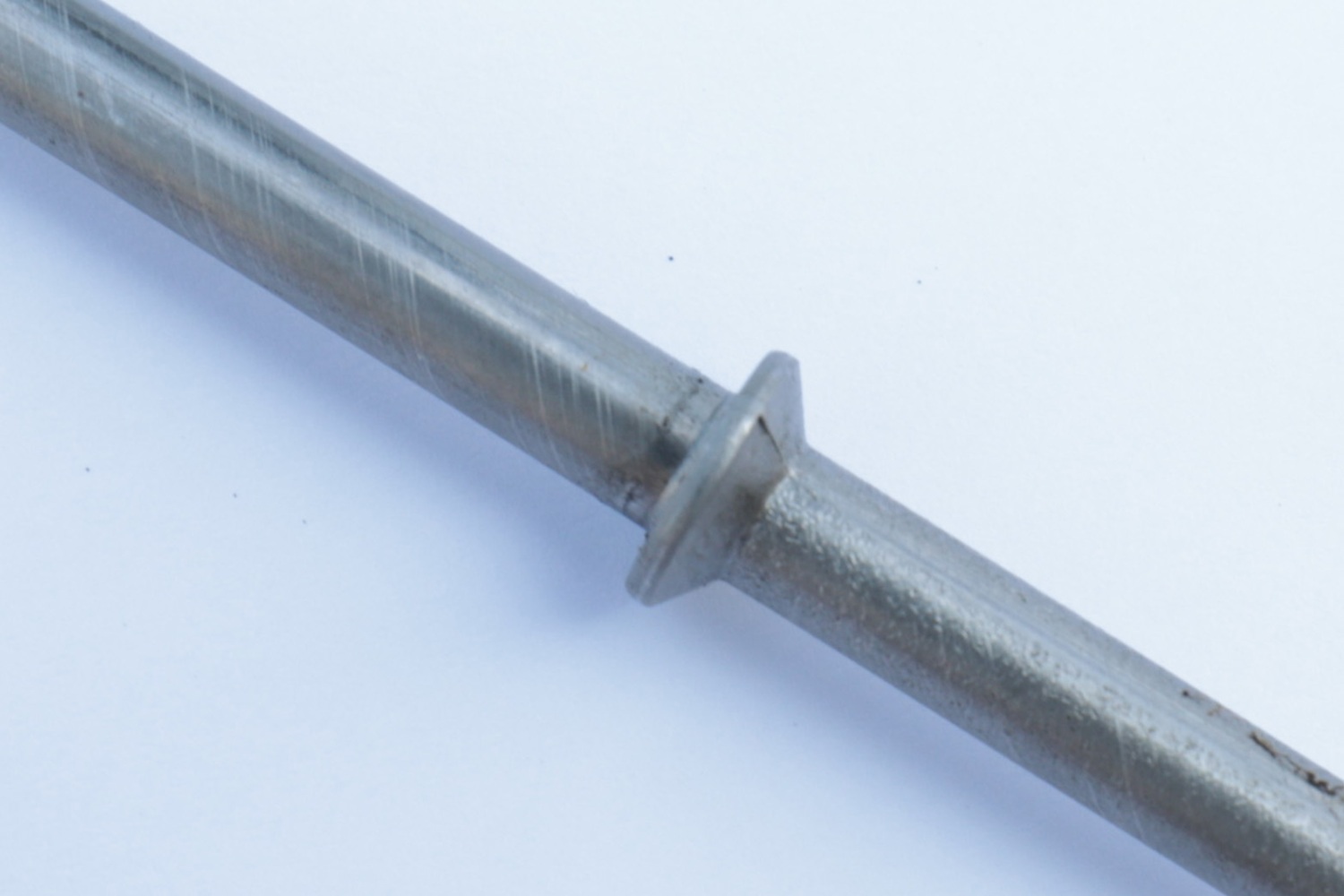 Close-up of a metal rod with an integrally formed raised collar
The raised collar is formed directly from the metal rod through localized compression. The collar and rod remain one continuous piece, without a separately attached ring or welded joint. This integral collar forming capability is a distinctive manufacturing feature of Pi Chan Metal.
Integral Collar Forming for One-Piece Metal Rods
Integral collar forming creates a raised collar directly from the material of a metal rod. Instead of attaching a separate ring, the process forms the protruding feature from the rod itself, leaving the collar and shank as one continuous piece.
Pi Chan Metal Co., Ltd., based in Changhua, Taiwan, uses this forming capability to produce integral raised features on metal rods. The collar is formed through localized compression, without welding a separate collar onto the rod.
For buyers developing a drawing-specific component, this offers a manufacturing approach worth evaluating when a raised stop, locating feature, or defined contact surface is required along a rod.
Submit your drawing to discuss collar geometry, position, rod dimensions, material requirements, and manufacturing feasibility.
What Is an Integrally Formed Collar?
An integrally formed collar is an enlarged section that belongs to the rod itself. It is not a separately manufactured ring fitted over the shank.
The term “integral” describes this one-piece relationship. The precise shape may vary according to the drawing, so buyers should specify the collar profile rather than relying on the word alone.
| Term | Meaning | Purchasing Detail |
|---|---|---|
| Integral collar | Raised feature continuous with the rod | Specify one-piece construction |
| Collar diameter | Outside diameter of the enlarged section | Define clearance and contact requirements |
| Collar thickness | Axial width of the feature | Show the required dimension |
| Collar position | Location along the rod | Measure from a defined reference |
| Collar profile | Shape of the edges and transitions | Include critical mating details |
| Adjacent shank | Rod sections on either side | Specify relevant diameters and tolerances |
A clear section drawing helps explain how the collar interacts with the surrounding components.
Pi Chan’s Integral Collar Forming Capability
Pi Chan forms the raised collar directly from the parent rod material. Localized compression causes material to move into the required enlarged profile.
This construction removes the need to attach a separate ring for that feature. It also means the collar’s position and dimensions are manufacturing requirements established by the approved drawing.
The process is particularly relevant to buyers who need a formed feature in the middle of a rod rather than only at its end.
| Manufacturing Characteristic | Pi Chan’s Integral Collar Approach |
|---|---|
| Collar material | Comes directly from the rod |
| Construction | Collar and shank remain one continuous piece |
| Separate collar component | Not required for the formed feature |
| Welded collar attachment | Not used |
| Collar location | Defined by the approved part geometry |
| Dimensional feasibility | Reviewed against material and forming requirements |
| Performance requirements | Evaluated for the intended component and application |
For related capabilities, explore metal forming and processing.
Integral Collar Forming Compared with Other Construction Methods
A raised collar can be produced through different manufacturing routes. The appropriate choice depends on geometry, material, quantity, tolerances, and function.
Integral forming should be evaluated against the actual design rather than assumed to replace every welded, assembled, or machined configuration.
| Construction Method | How the Collar Is Created | Design Point to Review |
|---|---|---|
| Integral collar forming | Material from the rod is displaced into a raised feature | Formability, geometry, and achievable tolerances |
| Welded-on collar | A separate ring is attached by welding | Weld requirements and assembly control |
| Mechanically attached collar | A separate component is secured to the rod | Attachment method and retention |
| Machining from larger stock | Material is removed while leaving a raised section | Stock size and machining requirements |
The absence of a welded collar joint is a construction feature. It does not, by itself, establish a particular strength, fatigue life, or load rating.
When to Consider a Rod with an Integral Collar
An integral collar may be considered where the component needs a fixed raised feature along its length.
Depending on the assembly, that feature may provide an axial stop, define a position, or contact another component. These functions must be confirmed through the connection design.
| Design Requirement | Potential Role of the Collar | Information Needed |
|---|---|---|
| Axial positioning | Establishes a defined position along the rod | Reference dimensions and permitted variation |
| Travel limitation | Acts as a stop against a mating component | Contact geometry and loading conditions |
| Assembly spacing | Helps define a distance within the assembly | Component stack and functional dimensions |
| Contact surface | Provides a raised seating area | Required face geometry and surface condition |
| Separate-ring replacement | Integrates a previously separate feature | Existing design and acceptance requirements |
These examples describe possible design functions, not approved applications or guaranteed performance.
For a component that also needs threads, a head, or other fastening features, see special screw manufacturing.
Dimensions Needed for an Integral Collar Forming Inquiry
A useful drawing defines the complete rod and the collar’s relationship to it.
Identify the reference used to locate the collar. For example, the dimension may be taken from a specified rod end, the underside of a head, or another controlled feature.
| Drawing Item | What to Specify | Why It Matters |
|---|---|---|
| Rod diameter | Size and tolerance | Defines the parent body and mating fit |
| Overall length | Finished length and reference | Establishes the complete part |
| Collar diameter | Outside diameter and tolerance | Controls radial clearance |
| Collar thickness | Axial dimension | Affects assembly fit |
| Collar position | Distance from a defined datum | Locates the functional feature |
| Transition profile | Required radii or edge geometry | Defines clearance near the collar |
| Straightness | Requirement and inspection reference, if critical | Supports fit in long assemblies |
| Threads and end features | Dimensions and positions | Completes the specification |
Mark the dimensions that directly affect function. Unnecessarily tight tolerances can restrict manufacturing options, while unclear functional dimensions can leave important requirements unresolved.
Material and Surface Finish Requirements
Material selection affects whether the proposed feature can be formed and whether the finished part meets the application requirements.
Specify the required material grade and mechanical properties. Avoid relying only on broad descriptions such as “steel,” “stainless,” or “high strength.”
| Requirement | Details to Provide |
|---|---|
| Material | Grade or applicable specification |
| Mechanical properties | Required strength, hardness, or other properties |
| Service environment | Moisture, temperature, chemicals, or outdoor exposure |
| Surface treatment | Required coating or finish |
| Mating materials | Materials contacting the rod and collar |
| Surface quality | Functional and visible surface requirements |
| Documentation | Required material or inspection records |
Availability and process compatibility must be confirmed for the complete design. A formed collar’s appearance alone does not establish material grade or performance.
Combining Collar Requirements with Long Rods and Special Screws
Some projects need both extended length and a raised feature at a controlled position. Others require a collar near a threaded section or formed end.
Include all features in the same drawing so their relationships can be reviewed together. A feasible collar and a feasible thread do not automatically make every combined configuration feasible.
Pi Chan’s extra long screws page provides a related product category for extended-reach inquiries. Confirm the complete combination of length, diameter, collar geometry, material, and thread requirements before ordering.
Inspection and Sample Approval
Agree on acceptance criteria before production. Inspection should focus on the features that determine fit and function.
If samples are supplied, evaluate them with representative mating components. Record the drawing revision and any agreed inspection or assembly results.
| Inspection Topic | Requirement to Agree |
|---|---|
| Collar size | Diameter, thickness, and permitted variation |
| Collar location | Measurement reference and positional tolerance |
| Rod geometry | Diameter, length, and straightness where required |
| Transition areas | Drawing requirements and acceptable surface condition |
| Threads or ends | Dimensions and relevant inspection criteria |
| Material properties | Required evidence or testing |
| Assembly trial | Fit, seating, clearance, and functional checks |
| Product identification | Part number, revision, and required batch information |
These are topics for agreement with the supplier. Sampling, testing, and documentation availability require confirmation for each project.
Request an Integral Collar Forming Review
To discuss your component with Pi Chan, send a drawing showing the rod, raised collar, and any additional features.
Explain what the collar does in the assembly and identify the surfaces or dimensions that control that function. Include the material, finish, quantity, delivery destination, and requested date.
If you are replacing an existing separate collar, provide the current assembly drawing and the requirements the replacement must meet.
Contact Pi Chan Metal to discuss manufacturing feasibility, tooling requirements, pricing, and delivery arrangements.
Integral Collar Forming FAQ
What Is Integral Collar Forming?
It is a process that creates a raised collar directly from metal rod material. The collar and rod remain one continuous piece rather than using a separately attached ring.
Is the Collar Welded onto the Rod?
For Pi Chan’s integral collar construction, no separate collar is welded onto the rod. The raised feature is formed from the rod itself through localized compression.
What Is the Best English Product Name?
“Metal rod with an integral collar” clearly describes the finished component. “Integrally formed collar” describes the raised feature, while “integral collar forming” describes the manufacturing capability.
Can the Collar Be Formed in the Middle of a Rod?
Pi Chan’s described capability includes forming a raised feature along the rod body. Submit the required location, rod dimensions, collar geometry, and material for review. Feasibility depends on the complete specification.
Is an Integral Collar the Same as a Separate Shaft Collar?
No. A separate shaft collar is an additional component attached to a shaft or rod. An integral collar is part of the rod material itself. Their installation methods and functional requirements can differ.
Can Integral Forming Replace a Welded Ring?
It may be an option after design review. Compare dimensions, tolerances, material, contact conditions, and loading requirements. Validate the proposed replacement against the actual assembly before approval.
Can the Collar Be Repositioned After Manufacturing?
An integral collar is a fixed formed feature. It should not be treated as an adjustable separate collar. Specify its required position and tolerance before manufacturing.
Does One-Piece Construction Mean the Part Is Stronger?
Not automatically. Strength depends on material, geometry, processing, and loading. Any comparison requires evidence for the particular designs being evaluated.
Is Integral Collar Forming the Same as Extrusion?
The terms are not interchangeable. Integral collar forming describes the feature being produced. “Extrusion” identifies a particular metalworking operation. The manufacturing route should be confirmed against the actual process.
What Drawing Details Are Most Important?
Include rod diameter, overall length, collar diameter, collar thickness, collar position, and transition geometry. Add threads, end features, material, finish, tolerances, and the drawing revision where applicable.
Can Threaded Sections Be Included?
Show the required thread designation, length, and position relative to the collar. Pi Chan must review the complete combination of features before confirming feasibility.
Can Any Metal Be Used?
Material suitability depends on the forming requirements and finished-part performance. Specify the required grade for review rather than assuming every material can produce the same collar geometry.
Are Samples Available for Evaluation?
Ask about sample availability, cost, and lead time during quotation. If samples are supplied, agree on dimensional and assembly acceptance criteria before approving production.
What Are the Minimum Order Quantity and Lead Time?
They depend on geometry, material, tooling, finish, quantity, and the production schedule. Include your requested delivery date and destination when submitting an inquiry.
- Integral Collar Forming
- Metal Rod with Integral Collar
- One-Piece Metal Forming
- Custom Metal Rod Forming
- Cold Upsetting Services(確認為冷加工後使用)
- Cold-Formed Rods with Integral Collars(確認為冷加工後使用)